
By Cure Rituals Editorial Team • 9 min read • March 2026
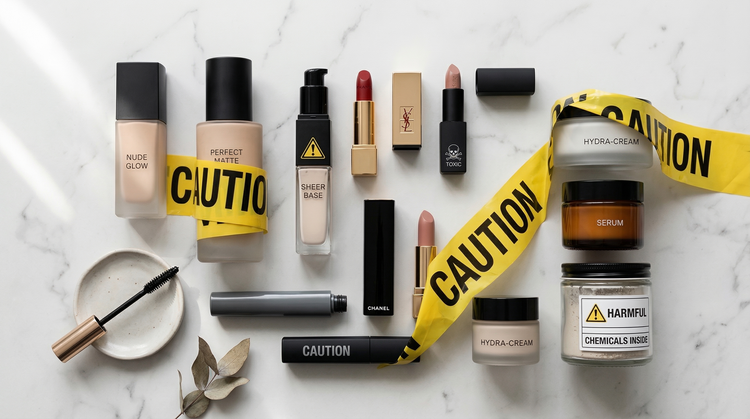
You apply foundation in the morning. A swipe of mascara. Maybe a long-lasting lipstick before heading out the door.
It feels harmless even empowering. But what if the very products designed to make you look and feel your best were quietly depositing toxic chemicals into your bloodstream? Chemicals that never break down. Chemicals the scientific community calls "forever."
In January 2026, the FDA released a landmark report confirming what clean beauty advocates had feared for years: more than 50 types of PFAS — per- and polyfluoroalkyl substances, commonly known as "forever chemicals" — are intentionally added to nearly 1,700 cosmetic products sold in the United States. And the agency admitted it doesn't have enough data to confirm they're safe.
This isn't a fringe concern. This is a public health reckoning hiding in your makeup bag.
In This Article
What Are PFAS, and Why Should You Care?
PFAS are a family of over 15,000 synthetic chemicals built around one of the strongest bonds in chemistry: the carbon-fluorine bond. That bond is what makes them virtually indestructible. They don't break down in the environment. They don't break down in your body. Once they're in, they accumulate — in your blood, your organs, your tissues — for years.

The carbon-fluorine bond — virtually indestructible, and now in your cosmetics
The cosmetics industry uses PFAS because they're remarkably functional. They create that smooth, silky feel in your foundation. They make your mascara waterproof. They help your lipstick stay put for hours. But that convenience comes with a biological cost that scientists are only beginning to fully understand.
The Health Risks Are Alarming
Peer-reviewed research has linked PFAS exposure to a growing list of serious health concerns:
Cancer. A 2025 study estimated that PFAS in drinking water alone is responsible for 4,626 to 6,864 cancer cases annually in the U.S. PFAS has been associated with cancers of the kidney, breast, testicles, prostate, and thyroid.
Endocrine disruption. PFAS interfere with the homeostasis of estrogen, androgen, and thyroid hormones. For women, this can manifest as irregular menstrual cycles, fertility challenges, thyroid dysfunction, and increased cancer risk.
Immune system suppression. Research shows that PFAS exposure reduces vaccine effectiveness, particularly in children. Studies have documented decreased antibody concentrations for measles, diphtheria, and tetanus vaccines in children with higher PFAS blood levels.
Reproductive and developmental effects. PFAS exposure has been linked to low birth weight, accelerated puberty, reduced fertility, and pregnancy-induced hypertension. Some researchers believe the effects may be epigenetic — meaning they could be passed down to future generations.
Metabolic disruption. Obesity, type 2 diabetes, cardiovascular disease, elevated cholesterol, and reduced kidney function have all been connected to chronic PFAS exposure.

PFAS accumulates in your organs — thyroid, kidneys, liver, and reproductive system are most affected
Where Are PFAS Hiding in Your Beauty Routine?
The short answer: almost everywhere you'd least expect.
A groundbreaking study by the Green Science Policy Institute tested hundreds of cosmetic products and found organic fluorine — a marker for PFAS — in a staggering percentage of everyday beauty items:
- Waterproof mascara: approximately 80% contained PFAS
- Liquid lipstick: approximately 60% contained PFAS
- Foundation: approximately 60% contained PFAS
- Lip products overall: 76% had detectable fluorine levels
- Eye products (shadows, liners): among the highest concentration categories

Product categories most contaminated with PFAS — mascara and lipstick lead the list
The FDA's own 2026 report confirmed that eye shadows, face and neck leave-on products, eyeliners, face powders, and foundations are the top five product categories containing intentionally added PFAS, making up roughly 56% of all PFAS-containing cosmetics on the market.
The Labeling Problem
Here's what makes this especially troubling: PFAS appeared on the ingredient label of only about 8% of the products that tested positive. That means 92% of products containing PFAS don't disclose it.
When PFAS do appear on labels, they hide behind technical names most consumers wouldn't recognize:
- PTFE (polytetrafluoroethylene) — found in 28%+ of eyeshadows tested
- Perfluorononyl dimethicone
- Perfluorodecalin
- Perfluorohexane
- Trifluoroacetyl tripeptide-2
The common thread? Look for the prefix "fluoro" or "perfluoro" in any ingredient name. If it's there, PFAS is likely present.

Can you read your labels? Most PFAS ingredients hide behind names you'd never recognize
The Regulatory Landscape: Who's Protecting You?
The honest answer in 2026? It depends on where you live.
Federal Level: Insufficient Action
Despite releasing its landmark PFAS-in-cosmetics report in late 2025, the FDA acknowledged that toxicological data for most PFAS used in cosmetics is "incomplete or unavailable." The agency found that only five of the reviewed PFAS substances appeared to pose few safety concerns — but couldn't definitively establish the safety of the rest.
Currently, there are no federal regulations that specifically prohibit PFAS intentionally added to cosmetic products.
State Level: A Patchwork of Progress
Already in effect (January 2025): California, Colorado, Maryland, and Minnesota have banned intentionally added PFAS in cosmetics.
Coming soon: Vermont and Washington have enacted bans taking effect between 2025 and 2028.
On the horizon: The Beauty Justice Act, a federal legislative push, is expected to receive renewed attention before the congressional session ends in June 2026.

Green = PFAS banned in cosmetics • Amber = Legislation pending • Gray = No action yet
How to Protect Yourself Starting Today
You don't have to wait for regulators to catch up. Here's how to take control of your beauty routine right now.
1. Learn the Red-Flag Ingredients
Scan your product labels for any ingredient containing "fluoro" or "perfluoro." The most common PFAS found in cosmetics include PTFE, perfluorononyl dimethicone, perfluorodecalin, and perfluorohexane. If you see these, put the product back.
2. Use Ingredient-Checking Tools
Download the EWG Skin Deep app or Think Dirty app. Both allow you to scan product barcodes and instantly see safety ratings and ingredient breakdowns, including PFAS flags.
3. Question "Waterproof" and "Long-Lasting" Claims
These performance claims are the biggest indicators of PFAS use. Waterproof mascara, long-wear foundation, and transfer-proof lipstick achieve those properties largely through fluorinated compounds. Ask yourself: is 12-hour wear worth the exposure?
4. Choose Verified PFAS-Free Brands
Several independent brands have been tested and confirmed to contain no detectable PFAS. Look for certifications including MADE SAFE, EWG Verified, COSMOS Organic, or USDA Organic as reliable starting points.
5. Embrace the Cure Rituals Philosophy
At Cure Rituals, we believe that you should never have to choose between performance and purity. Every Cure Rituals product is 100% botanical, with zero synthetic additives, zero PFAS, and zero compromise. We publish every ingredient's origin and what it replaces because radical transparency isn't a marketing strategy — it's a responsibility.
Ready to make the switch?
Our Miracle Cream is 100% botanical — Arnica Montana, Shea Butter, Natural Peppermint, and Vitamin E. Zero synthetics. Zero PFAS. Zero compromise.
Shop Miracle Cream →The Bigger Picture
PFAS in cosmetics isn't an isolated issue. It's part of a larger pattern in which the personal care industry has been allowed to self-regulate with minimal oversight, putting profit before consumer safety.
Consider this: over 10,000 additives are permitted in U.S. products with limited safety reviews. The European Union has banned phthalates, certain parabens, and hundreds of other chemicals that American consumers are still exposed to daily.
Every time you choose a clean, botanical product over a synthetic alternative, you're voting with your dollar. You're telling the industry that transparency matters. That your health isn't negotiable.
What Comes Next
This is the first in an ongoing series of Harmful Ingredients deep dives from Cure Rituals. We'll continue to investigate the chemicals hiding in everyday products, translate the science into actionable guidance, and provide you with clean alternatives that actually work.
Because your body deserves better than chemicals.
Related Reading
Sources & References
- FDA Report: "Report on the Use of PFAS in Cosmetic Products and Associated Risks" (December 2025)
- Environmental Working Group: "FDA Reports Over 50 PFAS Ingredients Intentionally Added to 1,700 Personal Care Products" (January 2026)
- National Institute of Environmental Health Sciences: "Cancer Cases Attributable to PFAS in Drinking Water" (February 2025)
- Agency for Toxic Substances and Disease Registry (ATSDR): "PFAS and Your Health — Health Effects"
- Green Science Policy Institute: "PFAS in Cosmetics"
- Stanford Medicine: "PFAS, aka Forever Chemicals: What the Science Says" (2024)
- Morgan Lewis: "State PFAS Bans in Cosmetics Expand Ahead of 2026" (December 2025)
Stay Informed. Stay Clean.
Join the Cure Rituals community for weekly deep dives into harmful ingredients, clean recipes, and plant medicine wisdom.
Join the Community →